


Fig 2
Download original image
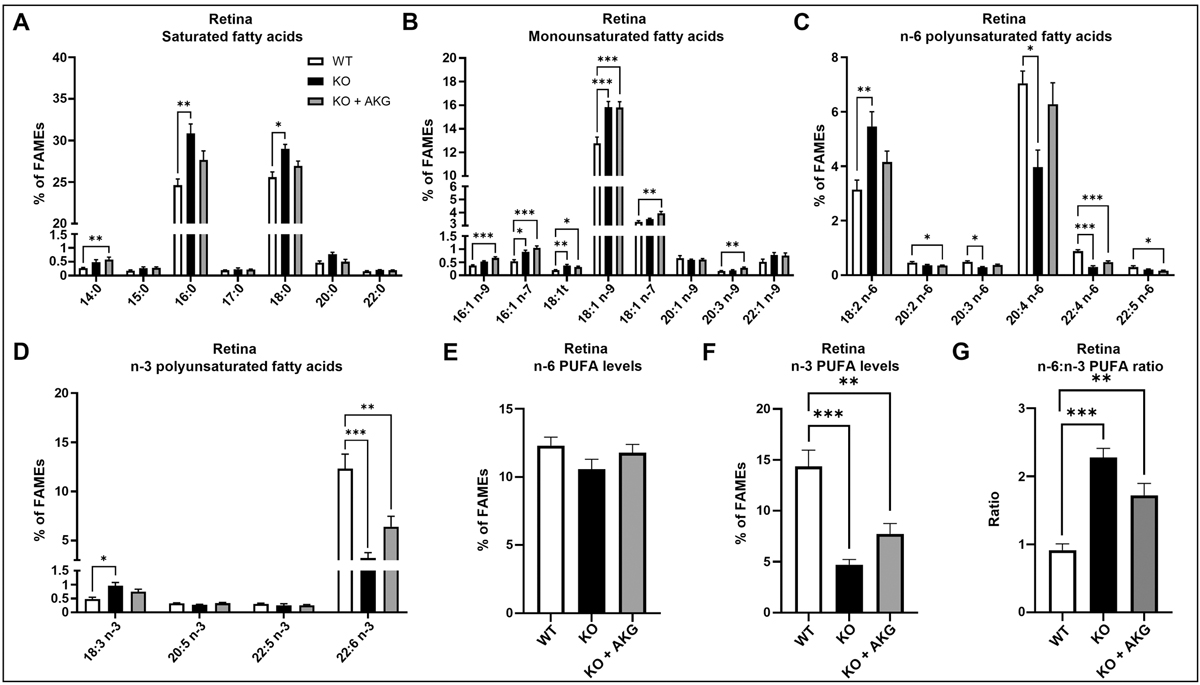
Plasmalogen deficiency is associated with major alterations of fatty acid species in the pups retina that are partially prevented by maternal AKG supplementation. A) Saturated fatty acids profile. Plasmalogen deficiency was associated with an increase in palmitic acid (16:0) and stearic acid (18:0) concentrations. AKG maternal supplementation partially restores their levels. B) Monounsaturated fatty acids profile. Plasmalogen deficiency was associated with an increase in several monounsaturated chains, especially in oleic acid (18:1n−9), that are not restored by AKG maternal supplementation. C) n−6 polyunsaturated fatty acids (PUFA) profile. Plasmalogen deficiency was associated with several dysregulations, especially with an increase in C18:2n−6 (LA) and a decreased C20:4n−6 (ARA) levels, that are restored through maternal supplementation with AKG. D) n−3 PUFA profile. Plasmalogen deficiency was associated with several dysregulations, mostly characterized by a decrease in C22:6n−3 (DHA) levels, that was not restored through maternal supplementation with AKG. E) Plasmalogen deficiency was associated with a slight but not significant decrease in total n−6 PUFA. F) Plasmalogen deficiency was associated with a significant and dramatic decrease in total n−3 PUFA, that was not restored by AKG maternal supplementation. G) Plasmalogen deficiency was associated with a significant increase of the n−6:n−3 PUFA ratio in the retina. AKG nutritional supplementation partially restored the n−6:n−3 PUFAs ratio but remained significantly higher than in WT mice retina. FAMEs: Fatty acid methyl esters. * p <0.05; ** p <0.01; ***p <0.001. n = 4–8. One-way ANOVA with post-hoc Tukey’s multiple comparisons test.
Current usage metrics show cumulative count of Article Views (full-text article views including HTML views, PDF and ePub downloads, according to the available data) and Abstracts Views on Vision4Press platform.
Data correspond to usage on the plateform after 2015. The current usage metrics is available 48-96 hours after online publication and is updated daily on week days.
Initial download of the metrics may take a while.